AI Ecommerce Personalization: Transforming Customer Experiences in Online Retail
In this article
- AI Ecommerce Personalization: Transforming Customer Experiences in Online Retail
- Introduction
- Why AI Ecommerce Personalization Matters
- Core AI Tools for Personalized Ecommerce
- 1. Recommendation Engines
- 2. Chatbots and Virtual Assistants
- 3. Visual Search and Image Recognition
- 4. Voice Commerce
- Key Hyper Personalization Strategies in Ecommerce
- 1. Collect and Analyze Customer Data
- 2. Dynamic Customer Segmentation
- 3. Personalized Marketing Campaigns
- 4. Optimize Product Discovery
- Hyper Personalization in Retail: Real-World Examples
- Challenges of AI Ecommerce Personalization
- Best Practices for AI Ecommerce Personalization
- The Future of AI Ecommerce Personalization
- Conclusion
AI Ecommerce Personalization: Transforming Customer Experiences in Online Retail
Introduction
In the modern digital marketplace, shoppers expect more than just product availability. They want brands to understand their preferences, anticipate their needs, and offer recommendations tailored to them. This is where AI ecommerce personalization plays a crucial role.
Using artificial intelligence to deliver personalized experiences is no longer optional for businesses looking to grow online. Companies leveraging AI to create individualized interactions gain a competitive advantage, while those that ignore personalization risk losing customers to more innovative competitors.
This blog explores how AI ecommerce personalization is reshaping online retail, highlights key hyper personalization strategies, and provides actionable steps for businesses to implement a hyper personalized customer experience. Whether you are a small online retailer or a large enterprise, adopting AI-driven personalization can help your brand stay ahead in a competitive market.
Why AI Ecommerce Personalization Matters
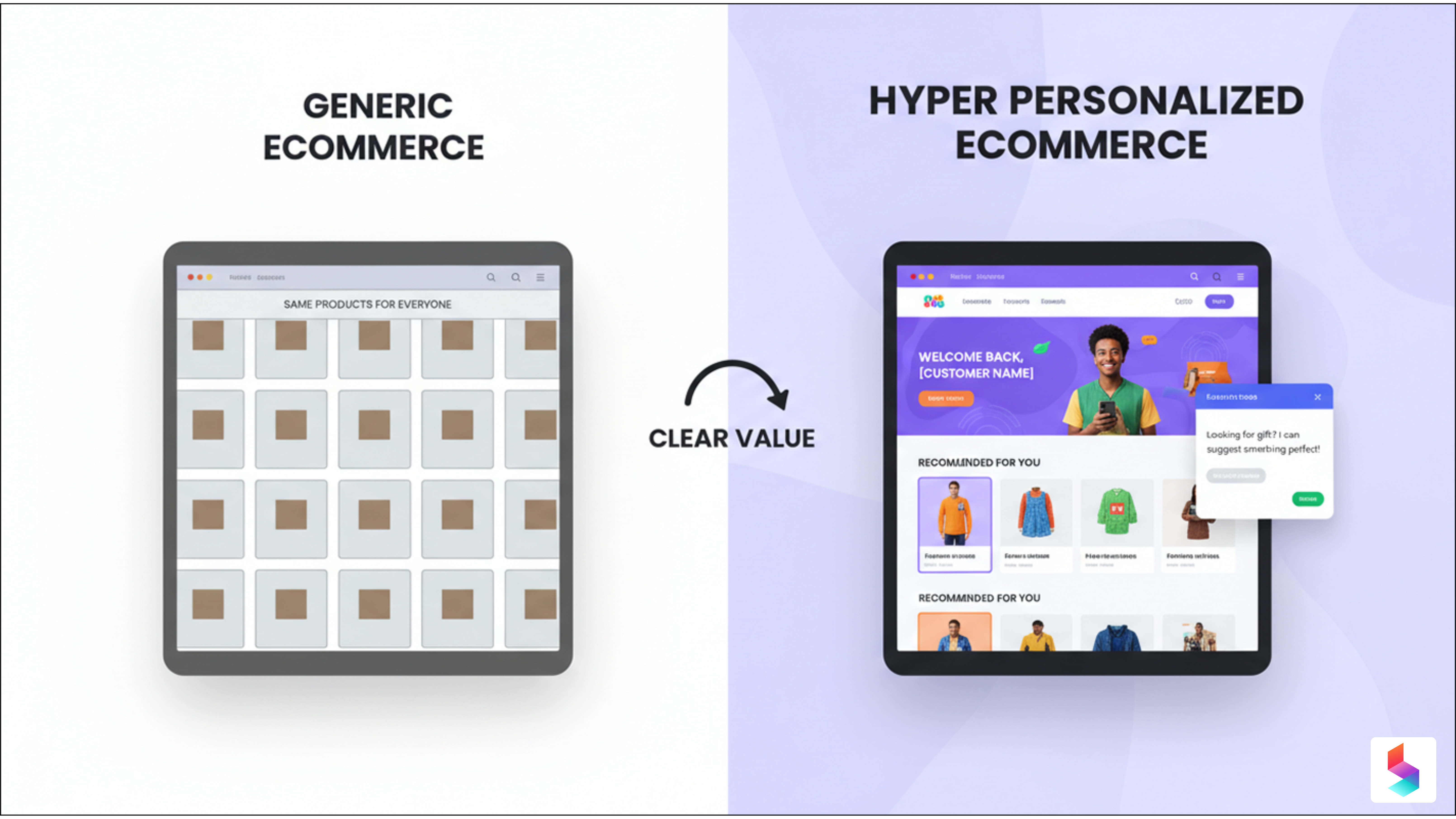
Consumers today expect online stores to understand them as individuals. Generic shopping experiences no longer satisfy their needs. Personalized experiences provide several benefits for both shoppers and businesses:
- Higher conversions: Customers are more likely to purchase when recommendations are tailored to their preferences.
- Stronger loyalty: Personal interactions make shoppers feel valued, increasing retention.
- Better engagement: Relevant offers and product suggestions keep visitors on your site longer.
According to research, companies that incorporate personalization into their ecommerce strategy can see a 20% increase in sales and a 10–15% boost in customer retention. This shows that implementing hyper personalization strategies is both a customer-centric and revenue-driven approach.
AI makes these experiences possible by analyzing customer data in real time and predicting what products or offers each shopper is most likely to engage with. From tailored recommendations to dynamic pricing and personalized campaigns, AI is transforming how businesses approach customer engagement.
Core AI Tools for Personalized Ecommerce
To deliver effective AI ecommerce personalization, businesses rely on a variety of tools available within a robust AI ecommerce platform, which centralizes recommendation engines, chatbots, and visual search for streamlined implementation and consistent customer experiences.
1. Recommendation Engines
AI-powered recommendation engines analyze browsing behavior, purchase history, and customer preferences to suggest relevant products. Applications include:
- Displaying recommended products on homepages and product pages.
- Offering upselling and cross-selling suggestions at checkout.
- Send personalized product recommendations via email.
Recommendation engines are a cornerstone of hyper personalization strategies, helping businesses increase sales while enhancing the hyper personalized customer experience.
2. Chatbots and Virtual Assistants
AI chatbots provide real-time support, suggest products, and guide customers through the purchase journey. Key benefits include:
- Immediate responses to customer inquiries.
- Personalized product recommendations based on individual preferences.
- Reducing ecommerce customer service workload while improving engagement and ensuring shoppers get timely assistance
Chatbots are a practical application of AI for delivering personalized interactions at a scale.
3. Visual Search and Image Recognition
Visual search allows customers to upload images or screenshots to find similar products. AI then identifies the item and provides personalized suggestions. This technology improves the hyper personalization approach by enabling shoppers to discover products more quickly and more intuitively.
4. Voice Commerce
Voice-activated shopping tools powered by AI enable hands-free search and purchases. Voice commerce enhances AI ecommerce personalization by making the shopping experience more convenient and tailored to each user.
Key Hyper Personalization Strategies in Ecommerce
AI is effective only when paired with a well-defined hyper personalization approach. Businesses should focus on these strategies:
1. Collect and Analyze Customer Data
Successful personalization begins with data. Companies should gather first-party data, including:
- Browse behavior and product interactions.
- Purchase history and frequency.
- Demographics, preferences, and customer feedback.
AI systems analyze this data to predict customer behavior and offer tailored recommendations, forming the foundation of hyper personalization strategies.
2. Dynamic Customer Segmentation
Rather than static segments, AI enables dynamic grouping of customers based on real-time behavior. This allows brands to target audiences with highly relevant content and campaigns, supporting a hyper-personalized customer experience.
3. Personalized Marketing Campaigns
AI enables marketing that goes beyond inserting a customer’s name into an email. Examples of hyper personalization marketing include:
- Personalized content on websites and emails tailored to each shopper.
- Push notifications or SMS offers based on predicted purchase intent.
- Customized promotions and campaigns aligned with customer interests.
This ensures that marketing efforts are more effective and resonate with individual customers.
4. Optimize Product Discovery
AI ensures shoppers find the products they want quickly. Personalized search results, tailored category pages, and individualized homepages reduce friction and increase conversions, forming an essential part of the hyper personalization approach.
Hyper Personalization in Retail: Real-World Examples
Many leading brands are successfully using AI to deliver personalized experiences:
- Amazon: Suggests products based on browsing history, previous purchases, and cart content.
- Nike: Offers personalized product recommendations and customized sneakers based on customer preferences.
- Sephora: Uses AI-driven virtual assistants and quizzes to recommend products suited to individual beauty profiles.
These examples show that hyper personalization in retail is now a standard expectation for consumers. Companies that fail to adopt AI-driven personalization risk falling behind competitors.
Challenges of AI Ecommerce Personalization
While AI provides significant advantages, implementing it can present challenges:
- Data Quality and Privacy: Accurate; high-quality data is essential. Brands must also comply with regulations like GDPR.
- System Integration: AI tools must work seamlessly with ecommerce platforms, CRM systems, and marketing tools.
- Resource Requirements: AI solutions may require significant investment in technology and skilled personnel.
A strategic approach, careful planning, and selecting the right AI tools can help businesses overcome these challenges and deliver effective hyper personalized customer experiences.
Best Practices for AI Ecommerce Personalization
To succeed with AI-driven personalization, businesses should:
- Start Small and Scale: Begin with one or two AI tools such as recommendations or chatbots, then expand as insights grow.
- Prioritize Customer Value: Focus on personalization strategies that enhance the shopping experience, not just drive sales.
- Track and Optimize: Use metrics like engagement, conversion rates, and customer satisfaction to refine personalization efforts.
- Maintain Transparency: Clearly communicate how customer data is used to build trust.
Following these best practices ensures a strong foundation for implementing hyper personalization strategies and achieving measurable results.
The Future of AI Ecommerce Personalization
AI is evolving rapidly, and so is its role in ecommerce personalization:
- Predictive Personalization: AI anticipates customer needs before they browse, offering proactive suggestions.
- Omnichannel Personalization: Customers receive consistent, personalized experiences across websites, mobile apps, email, and in-store interactions.
- Emotional AI: AI interprets customer sentiment to provide contextually relevant and empathetic recommendations.
In the next few years, hyper personalization in retail will move from being a competitive advantage to a standard expectation. Brands that adopt AI early will gain loyalty, drive sales, and achieve long-term growth.
Conclusion
AI ecommerce personalization is transforming how businesses interact with customers. From recommendation engines and chatbots to visual search and voice commerce, AI provides the tools needed to deliver a hyper personalized customer experience at scale.
Implementing AI successfully requires a strategic hyper personalization approach, collecting high-quality customer data, and applying AI-driven insights to marketing, product discovery, and engagement. Businesses that embrace these strategies can stay ahead in an increasingly competitive ecommerce landscape.
By prioritizing AI ecommerce personalization today, brands can ensure long-term growth, higher customer satisfaction, and market leadership in the retail space.
Frequently Asked Questions
1. What is AI ecommerce personalization?
AI ecommerce personalization is the use of artificial intelligence to tailor product recommendations, marketing, and shopping experiences to individual customer preferences.
2. Why is hyper personalization important in ecommerce?
Hyper personalization increases conversions, improves customer loyalty, and enhances engagement by delivering a tailored shopping experience.
3. What are common hyper personalization strategies?
Common strategies include AI-driven product recommendations, dynamic customer segmentation, personalized marketing campaigns, and optimized product discovery.
4. How can retailers implement hyper personalization?
Retailers can implement hyper personalization by collecting first-party customer data, using AI-powered tools like recommendation engines and chatbots, and continuously refining campaigns based on analytics.
5. What are the benefits of hyper personalized customer experiences?
Hyper personalized customer experiences lead to higher sales, improved retention, better engagement, and stronger brand loyalty.