Voice Ecommerce Is Transforming Online Shopping. Is Your Platform Ready?
In this article
- Voice Ecommerce Is Transforming Online Shopping. Is Your Platform Ready?
- Understanding Voice Ecommerce and Why It Matters
- How Voice Search Is Changing Ecommerce Behavior
- Why Ecommerce Platform Readiness Is Critical
- The Role of AI in Voice Ecommerce Growth
- Where Voice Based Shopping Makes the Biggest Impact
- What Makes an Ecommerce Platform Voice Ready
- How AI Ecommerce Platforms Simplify Voice Readiness
- Voice Ecommerce and the Future of Online Selling
- How Businesses Can Prepare Without Overcomplicating
- Final Thoughts
Voice Ecommerce Is Transforming Online Shopping. Is Your Platform Ready?
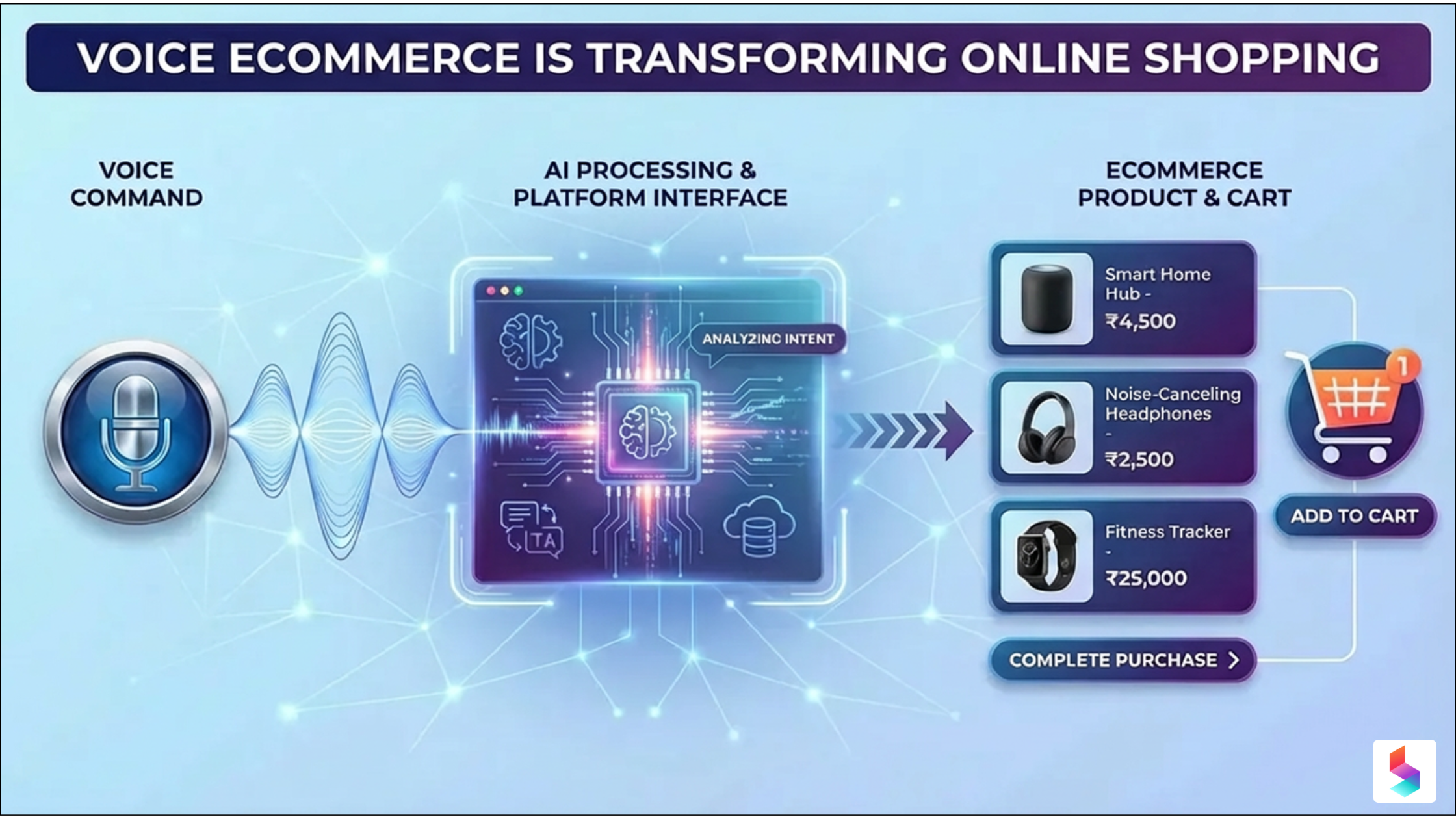
Voice ecommerce is no longer an emerging concept discussed only in innovation circles. It is actively transforming how customers search, evaluate, and purchase products online. As smart assistants, AI-powered voice search, and conversational interfaces become part of everyday life; ecommerce businesses face a critical question. Is your platform ready to support voice-driven shopping experiences?
For online sellers, this shift is not about replacing traditional ecommerce. It is about adapting to how customers naturally interact with technology today. Voice-based shopping removes friction, shortens decision-making time, and enables hands-free purchase. Businesses that prepare early will gain discoverability, customer loyalty, and long-term scalability.
This blog explores how voice ecommerce is reshaping online shopping, why platform readiness matters more than ever, and how businesses can prepare without overhauling their entire tech stack.
Understanding Voice Ecommerce and Why It Matters
Voice ecommerce refers to the use of voice-enabled devices and assistants to search for products, compare options, and complete purchases online. Customers use voice commands through smartphones, smart speakers, and connected devices to interact with ecommerce platforms.
Unlike traditional typed searches, voice search ecommerce relies on conversational queries. Customers speak naturally, asking full questions instead of short keywords. This behavior is redefining how products are discovered and ranked online.
Voice ecommerce matters because it aligns with modern consumer expectations. Shoppers want speed, convenience, and personalization. Voice-based shopping delivers all three by allowing users to search and buy while multitasking, without screens or manual input.
As voice adoption increases, ecommerce platforms that fail to support this behavior risk losing visibility and relevance.
How Voice Search Is Changing Ecommerce Behavior
Voice search ecommerce has introduced a major shift in customer intent and search patterns. People speak differently than they type, and platforms must adapt to this change.
Instead of typing fragmented phrases, users ask complete questions and describe their needs clearly. For example, a customer is more likely to say, “find a lightweight running shoe for daily workouts” than type “running shoes lightweight.”
This shift impacts ecommerce in several ways:
- Search queries are longer and more specific
- Product descriptions must be conversational and benefit-focused
- SEO strategies must prioritize natural language
- Structured data becomes essential for accurate results
Voice-based shopping also increases impulse purchases and repeat orders. When reordering is as simple as speaking a command, customer retention improves significantly.
Why Ecommerce Platform Readiness Is Critical
Many businesses assume voice ecommerce requires building complex voice applications or custom integrations. Readiness depends on the foundation of your ecommerce platform.
A voice-ready platform supports:
- Clean and structured product data
- Conversational product descriptions
- SEO-friendly page architecture
- Fast loading and mobile optimization
- AI-driven content generation
If these elements are missing, voice search results may bypass your store entirely, even if your products are competitive.
Platform readiness ensures that your ecommerce store can interpret voice queries, match them to relevant products, and deliver accurate results across devices and channels.
The Role of AI in Voice Ecommerce Growth
AI ecommerce platforms play a central role in enabling voice commerce. Artificial intelligence powers voice recognition, natural language processing, and personalized search experiences.
An AI powered ecommerce platform helps businesses:
- Generate conversational product descriptions
- Understand customer intent more accurately
- Optimize content for voice search ecommerce
- Deliver AI ecommerce personalization by tailoring product recommendations and content to individual users
- Automate catalog and metadata optimization
Without AI, scaling voice ecommerce becomes difficult. Manual optimization is time-consuming and inconsistent. AI ensures that content stays aligned with how customers search and speak.
As voice adoption grows, ecommerce platforms that integrate AI at the core will adapt faster and perform better.
Where Voice Based Shopping Makes the Biggest Impact
Voice-based shopping is not limited to one type of product or business model. However, certain scenarios benefit more immediately from voice commerce adoption.
Routine and Repeat Purchases
Products that customers buy frequently are ideal for voice ecommerce. Once a customer trusts a brand, voice reordering becomes a natural habit.
Product Discovery and Research
Voice search ecommerce supports early-stage discovery. Customers ask questions, compare options, and explore alternatives without browsing multiple pages.
Multitasking and Mobile Users
Voice-based shopping suits users who are driving, cooking, or working. Convenience becomes a competitive advantage.
Subscription and Refill Models
Voice commands simplify recurring purchases and subscription renewals, improving customer lifetime value.
Platforms that support this use cases gain stronger engagement and retention.
What Makes an Ecommerce Platform Voice Ready
Voice readiness is built into the structure of the platform, not added later as a feature. Ecommerce businesses should evaluate their platform against the following criteria.
A voice-ready ecommerce platform includes:
- Conversational product titles and descriptions
- Structured data and schema markup
- Search-friendly category and attribute tagging
- AI-powered content optimization
- Marketplace compatibility for voice search results
These elements ensure that voice assistants can accurately interpret product information and present it to users.
Platforms designed as AI ecommerce platforms naturally align with voice search requirements, reducing manual effort for sellers.
How AI Ecommerce Platforms Simplify Voice Readiness
AI ecommerce platforms reduce the complexity of preparing voice commerce. Instead of relying on multiple tools, businesses benefit from a unified system that handles content, SEO, and product intelligence.
With an AI powered ecommerce platform, businesses can:
- Automatically optimize listings for voice search ecommerce
- Maintain consistency across product catalogs
- Improve discoverability without technical intervention
- Adapt content based on search behavior trends
This approach allows businesses to focus on growth while the platform supports emerging shopping behaviors.
Voice Ecommerce and the Future of Online Selling
Voice ecommerce is not replacing traditional ecommerce experiences. Instead, it is becoming an additional layer that filters how customers find and interact with brands.
As voice adoption increases:
- Search results become more competitive
- Only well-structured content is surfaced
- Platforms act as enablers or blockers of growth
- AI-driven optimization becomes non-negotiable
Businesses that delay preparation may struggle to catch up later. Voice-based shopping rewards platforms that prioritize clarity, structure, and intelligence from the beginning.
How Businesses Can Prepare Without Overcomplicating
Preparing for voice ecommerce does not require a complete platform migration or expensive custom development. It requires choosing a platform that already supports modern ecommerce needs and integrates ecommerce customer service tools to handle inquiries from voice-driven interactions seamlessly, ensuring a smooth shopping experience.
Practical steps include:
- Using conversational language in product content
- Ensuring SEO fundamentals are in place
- Leveraging AI ecommerce platform capabilities
- Structuring product data cleanly
- Optimizing for mobile and speed
When these basics are implemented, voice readiness becomes a natural outcome rather than a separate initiative.
Final Thoughts
Voice ecommerce is transforming online shopping by changing how customers search, decide, and buy. The real challenge for businesses is not adopting voice technology, but ensuring their ecommerce platform is ready to support it.
Platforms that combine AI capabilities, structured data, and conversational content will lead to the next phase of ecommerce growth. Voice search ecommerce favors businesses that prioritize clarity, accessibility, and intelligent automation.
As voice-based shopping continues to rise, the question is no longer whether voice ecommerce matters. The question is whether your platform is prepared to meet customers where they are headed next.
Frequently Asked Questions
1. What is voice ecommerce?
Voice ecommerce allows customers to search for products and make purchases using voice commands through smart assistants and voice-enabled devices.
2. How does voice search impact ecommerce platforms?
Voice search ecommerce requires platforms to support conversational content, structured product data, and fast, mobile-friendly experiences.
3. Do businesses need special apps for voice-based shopping?
No, most businesses can support voice-based shopping by using a voice-ready, AI ecommerce platform with proper SEO and data structure.
4. Why is AI important for voice ecommerce?
AI helps ecommerce platforms understand natural language, optimize product content, and match spoken queries with the right products.
5. Is voice ecommerce only for large brands?
No, small and growing businesses can benefit from voice ecommerce by choosing an AI powered ecommerce platform built for scalability.